Blog Archive

Showing posts with label clicker training. Show all posts

Wednesday, March 12, 2014

Highlights of ClickerExpo 2014


For the last 5 years, I have attended ClickerExpo, a conference about clicker training.  Over 3 days, master instructors from North America and Europe present lectures and hands-on labs, mostly focused on dog training.

Here are a few highlights from 
this year's conference.

In a session on nosework, 
Ken Ramirez (Executive VP Animal
Programs and Training, Shedd Aquarium
and consultant to trainers worldwide)
presented an overview of training 
techniques used by a variety of 
professionals to train dogs to alert
to scent discrimination. This includes training dogs
 to detect bombs, drugs,
agricultural products, missing people and more.  These trainers want a 
very high level of accuracy and invest a huge amount of time training their
dogs. Ken discovered that giving the dog a way to communicate "All Clear"
virtually eliminated false alerts. Most handlers just train the dog to
alert - sitting, or running back to handler, or doing a certain action -
when they find the target item, and otherwise they are to keep searching until 
the handler calls them off the search. Ken's addition to the training gives the 
dog a way to communicate "I have looked everywhere in this area and there is nothing here", 
and it allows every cued search to be rewarded.

In general, we don't train our dogs to cue us very much, mostly we want to give them cues.  We often find 
the cues they do use (barking, whining, pawing come to mind) as annoying, and we may perceive that they
are trying to communicate something, but we don't know what it is.  There is a lot of territory here for us to explore
and to learn how to help our animals communicate with us more easily.
 
Kathy Sdao ACAAB (Bright Spot Dog Training, former marine mammal trainer and author of Plenty in Life is Free
spoke on Premack's principle (Dr. David Premack, Emeritus Professor of Psychology University of Pennsylvania). 
Briefly stated, Premack's Principle is that "high probability behavior reinforces low probability behavior".  In effect, 
it means that we can use distractions to reinforce behaviors we want the dog to do.  Kathy reminded us that we 
often think of Premack's Principle as "eat your broccoli, then you will get ice cream"  when it is really about how 
likely the behavior is, how often the behavior occurs, and the context in which the behavior occurs that matters. 
In any given context, a behavior that occurs more often than the one you are training can be used to reinforce the 
behavior you are training.

For example, you are training your young dog to walk politely on leash - a low probability behavior right now - 
you can use wandering and sniffing - a high probability behavior in this context - to increase the polite walking
on leash. Start by training polite walking inside (where there are few distractions), get to the point where you can
get several steps of polite walking on cue, then try it outside.  Cue polite walking and after several steps, release
your dog to wander and sniff (click here for instructions on how to train a release word) for a little while.  The
wandering and sniffing will reinforce (will make it more likely) that polite walking will occur.  I would also continue
to reinforce the polite walking with clicks and treats outside, mixed up with releasing to wander and sniff. 
Soon, your dog will be offering to walk politely, because it predicts such great rewards in his life. 
 
Photo courtesy of Kathy Blackburn
Hannah Branigan KPA CTP (Wonderpups Dog Training, author - Obedience Fundamentals DVD)
described how to break down the complex tasks required in competition obedience into simple steps. 
This is applicable to all training and I believe that the failure to break training tasks down into small enough
pieces for the dog to master easily is perhaps the biggest error that dog owners make.

First, identify the training task you are having difficulty with.  Take it out of it's usual context, break it down
into smaller parts, design an exercise that teaches that specific small part, shape and reinforce the behavior
you want, then but it back into it's appropriate context.  If you, or someone you know, needs help tackling a 
training problem, contact Dawn Gilkison at info@trainpositivedog.com or 971-255-7466.

Positive Solutions Dog Training

Sunday, November 17, 2013

The Eyes Have It - How to get your dog's attention

Eye contact - it's how humans are assured that someone is paying attention, it's what we want when we say our dog's name.  How do we get it?

Golden Retriever looks at the camera

Simply make it worthwhile for your dog to look at you when you say his name.  Starting in a quiet place indoors, wait for your dog to look at you, click and treat.  He looks again, click and treat.
In a few short sessions your dog will be offering you eye contact frequently.  Now you can add his name when he looks at you, and then click and treat.
You can drop the treat so he has to break eye contact, try saying his name, and click/treat when he looks at you.  That's the basics. 


When your dog has mastered the basic level, start asking for eye contact before you open the door to the backyard, before you throw the ball, or before you offer the tug toy.  When he looks at you, say your verbal marker (such as "YES!") and offer the toy, open the door, or give the life reward.  Soon your pup will offer the eye contact when you pick up the toy or go to the door - that's what you want!


All photos by Dawn Gilkison

Once your dog is reliably responding to his name at close range inside, start practicing when he is a bit farther away, or when there are distractions present. 
  • Say your dog's name ONCE.
  • No response?  No click/treat.
  • Wait a moment, try again.
  • Aim for a high rate of success. 
  • Practice in short sessions.
  • Add distractions OR distance.
  • Click as the dog's head turns.
This 9-week old puppy is on a mission and would probably not be able to respond to his name in this situation.
puppy pulling away on leash
To get your dog's attention in a distracting place, drop a treat in front of him, then at your feet, then wait for eye contact and click/treat that.  Realize that you need to train for attention if you want attention.
 

Positive Solutions Dog Training also provides in-home training in Multnomah and Clackamas counties in Oregon,  and in Vancouver, WA.

Call for more information - 971-255-7466 email info@trainpositivedog.com


Monday, November 11, 2013

Positive Does Not Mean Permissive

clicker in hand

Positive training focuses on training the behavior we want using positive reinforcement (stuff the dog likes) to increase that behavior and establish new patterns of behavior.  We don't let the dog "run amok" and do anything it wants.  We decide how we want the dog to act in a given situation and train for that.  We do set expectations for behavior and act consistently to reinforce good behavior and teach self control.  We do manage the environment to encourage the behavior we want and we do stop the dog from behaving in an unacceptable manner. 


The key is setting the dog up to succeed and rewarding success, not setting up the dog to fail and punishing that failure.  The clicker is a simple tool that allows the trainer to precisely mark the wanted behavior, and then deliver something the dog wants (food, toy, activity) after the click.

Smiling dog

Training should be fun! 

Fun for the dog and fun for the handler.  Really - if is not fun, why do it?  Why do you have a dog if not to enjoy it's company?  If you and your dog enjoy the training process, you will look forward to training sessions, learn more easily, and  accomplish your training goals more quickly than if you see training as a chore or worse, as a battle of wills.


Frequently, when I start working with a new client, they believe that they have to speak to their dog in a harsh, commanding tone.  This is an unfortunate leftover from "old school" dog training that emphasized domination and intimidation of the dog to achieve compliance.  This kind of training used physical punishment to back up the threat implied by the harsh tone of voice.  We know better now. 
Training with positive reinforcement establishes a clear system of communication with your dog that allows you to quickly train new behaviors and observe your dog eagerly participating in the process. 

Training should be effective
Guide Dogs For The Blind now uses clickertraining to train all of their dogs, and they have greatly increased the percentage of dogs graduating from their programs since they have changed over to force-free training.  If it works for them, it will work for you.

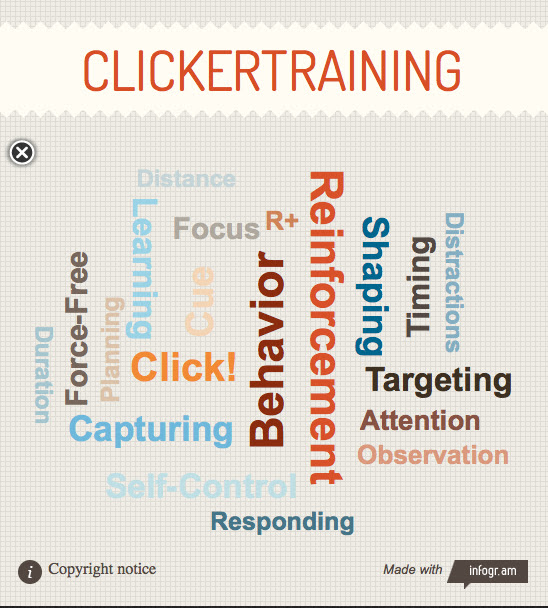
clickertraining infographic
I help dog owners transform their untrained animals into focused companions and responsive performance dogs - private, in-home training available in the Portland, Oregon metro area and training for attention and recall available online.  www.TrainPositiveDog.com   971-255-7466