Blog Archive

Showing posts with label dog training. Show all posts

Sunday, June 1, 2014

Bringing Change to Minds


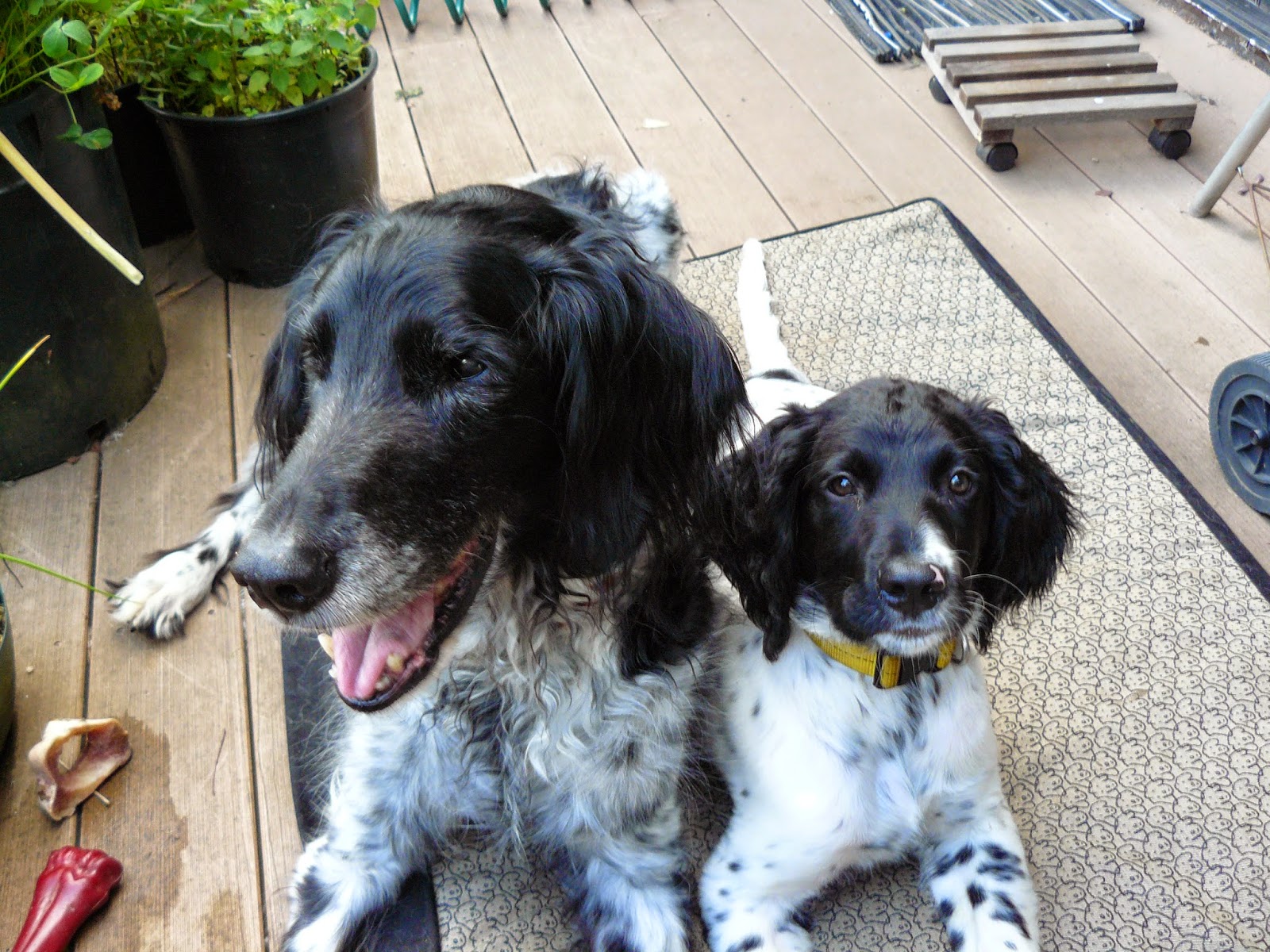
Pixel and puppy Deagan
I got my youngest dog, Deagan (the puppy pictured above), when he was 9 weeks old.  He is very inquisitive, active, and mouthy, which is characteristic of a breed selected to hunt, point, and retrieve birds.  Deagan is the third Large Munsterlander I have raised.  Of course, I started training and socialization right away, but I noticed that by 4.5 months of age, he was increasingly impulsive, and easily aroused to (inhibited) biting.  It was very difficult to interrupt behaviors I didn't want, and he was distracted by every object/event in his environment.

Yes, puppies are teething and exploring the world at this age, but Deagan's behavior was off the charts.  He just couldn't seem to leave anything alone unless he was in his crate or exercise pen, became almost frantic if he was thirsty or hungry, and sometimes became manic when exercising outside, launching himself at us and grabbing our arms.  Despite training for relaxation on a mat and self-control exercises, it was difficult for Deagan to calm down when he became over-excited, and restraining him often resulted in aggressive behavior (see this blog about conflict behavior).  


Despite getting plenty of physical exercise, Deagan was not able to settle down outside of his pen or crate.  As the weeks passed, it was more and more difficult to interrupt his aggressive behavior, and I was getting increasingly frustrated.  And angry.  And getting angry (not what I recommend to my clients!) at Deagan just caused him to get more excited and more aggressive.  What was the matter with this puppy? - I was providing him with the best care possible and he was so difficult to handle at times! Deagan was not like any puppy I had raised before.
 
Finally, when Deagan was about 8 months old, I did what I would suggest to a client - I consulted a veterinary behaviorist.  I did this because of the following:

The problem behaviors were not the result of a lack of training or a conditioned sequence of events.
There were multiple behavior issues.  
There were multiple triggers for the problem behaviors.  
The behavior was getting worse and was sometimes dangerous.  
Deagan's behavior was a serious problem for me and him.

A veterinary behaviorist is a veterinarian who specializes in treating behavior problems.  They are skilled in diagnosing and treating these problems with management, training, and sometimes with medication.  Medication is not a panacea and prescribing it is not taken lightly.  In addition, physical or medical issues are always a possibility when a behavior problem occurs, and must also be considered.
 
Some dog owners are wary of medications prescribed for behavior disorders.  They may be concerned that their dog will become a sedated "zombie" or may view medications as an irresponsible shortcut to dealing with the dog's problem behavior.  These misconceptions may prevent a dog owner from getting the help they need.  Medications that are used today for behavior disorders are not tranquilizers, and dosages are monitored carefully to avoid side effects.  In addition, medications are always used in conjunction with behavior modification (training).

And many people view the dog's problem behavior as solely being the owner's fault - perhaps as the result of not providing enough exercise or "leadership".  The reality is that all behavior has both inherited and environmental components and all dogs benefit from clear and consistent communication, positive reinforcement for good behavior, and a regular routine in their daily lives.  It is the job of the veterinary behaviorist to discover if the problem is the result of a lack of training, structure, or exercise in the dog's life; or if the problem has an underlying basis in the dog's physiology (genetic) or from traumatic experience (environmental).  Problems with underlying causes may benefit from medication prescribed in conjunction with training.

The veterinary behaviorist I consulted took a thorough history of Deagan's behavior and training, and made a detailed assessment of his behavior as well as reviewing his medical history.  Deagan was prescribed a commonly used selective serotonin reuptake inhibitor and continued positive training for self-control and relaxation.  Serotonin is neurotransmitter that helps relay signals from one part of the brain to the other and a shortage of it in the brain may lead to anxiety, panic, anger, depression, and obsessive/compulsive behavior (www.webmd.com).  The medication Deagan was prescribed keeps the level of serotonin in his brain higher than it would be without the drug.

The veterinary behaviorist confirmed that getting angry at Deagan was simply putting him into conflict, which resulted in the escalation of his level of arousal - counterproductive to what he needed - to develop more self-control.  In addition to continuing positive training for self-control and relaxation, my partner and I had to change some of our responses to Deagan's over-excited behavior.  We stopped playing "soccer" which often led to the launching and grabbing behavior, and started training specific calming behaviors that are incompatible with the over-excited behavior (whether it was directed toward other dogs or humans).
 
It is not possible to measure the level of serotonin in a living brain, and I cannot directly ask Deagan how he feels.  But I can make careful observations, and keep records of his behavior.  It can take several weeks for this type of medication to take effect and to establish the effective dose for an individual.  Over a period of several months, Deagan's behavior steadily improved.  The manic episodes and responses decreased and self-control increased.  Essentially, the medication that Deagan takes allows the training to take effect.


Deagan's blank facial expression seen in the 
puppy picture above has been replaced with 
a more relaxed, happy face.


We are able to play soccer again, safely, without Deagan escalating into a "launch and grab" episode.
Deagan sleeping in the office next to a bone


 Deagan is able to relax and fall asleep outside of his crate or pen which he was not able to do previously.


May was Mental Health Awareness Month for humans:  Bring Change 2 Mind is a national organization that is working to end the stigma and discrimination of mental illness.  A similar stigma extends to our companion animals and their owners.  I have avoided talking to very many people about Deagan's behavior problems because I am afraid of what they might think of me - as a responsible pet owner and a professional dog trainer.  I know that there are people who think that his problem behavior occurs because I don't get him enough exercise, or because I use positive training methods.  I know there are people who think that prescribing medication for behavior disorders in pets is wrong.  I have to remind myself that there are many misconceptions about mental illness and that keeping quiet doesn't help to end these misconceptions.  The Bring Change 2 Mind website states that "one of the best ways you can help someone with mental illness is by understanding what it is - and what it isn't.  After all, myths about mental illness contribute to stigma, which in turns prevents those who are living with one from seeking help."

Saturday, May 24, 2014

Conflict Behavior in Dogs


Conflict in dogs can be as simple as wanting to eat something they can't reach or being surprised by a strange, aggressive dog in a blind alley.  Dogs can be put into conflict when approached by a stranger, as they may be both attracted to the stranger and afraid at the same time. Starting at the bottom of the pyramid here is how conflict increases the arousal level of the dog:

Lowest Yellow Level:  When first put into conflict, dogs usually prefer to avoid conflict and will leave.  Often, they can't leave -  they are on leash with you, on the table at the vet office, in a small yard, etc.

Red Level - If they can't leave and confronted with a dog, or other animal (or person) they may show appeasement behavior - "please don't hurt me"- puppy-like behavior such as whining and pawing.
 

Blue Level - if conflict continues, the dog may show mixed signals - combination of submissive and aggressive behaviors: barking, backing away alternated with approaching, displacement digging, scratching

Orange Alert Level - growling - warning! If conflict continues, growling warns that a bite is coming.  Growling is important information from our dogs, and we should not try to suppress it by using punishment, which still leave the dog in a state of arousal.  Instead, we should work with the dog in a similar situation, in a lower state of arousal, to change their attitude so they are no longer in conflict.

Uppermost Levels - If conflict continues, snapping, then biting with contact.  Obviously, we want to avoid pushing the dog to this level.  Not all dogs will clearly go through all the levels before the BITE!, but bites do not "come out of nowhere" - there is always an indication of the escalation of arousal, but humans do not always see it.


Dogs do not always show all the behaviors described in the different levels of arousal - it depends on the type and intensity of the conflict, and the temperament and experience of the individual dog.

When dogs are in conflict situations, physical punishment can cause them to further escalate in arousal; it can cause them to move up the pyramid towards BITE!  That is why, if your dog is already aroused, yanking on their leash or collar, hitting them, or pushing the button on a shock collar is not a good idea.  It may simply cause them to be more aroused, increasing the aggressive behavior and moving the dog farther away from self control.  It is also possible that punishment may inhibit the behavior and bring the dog back to the appeasement level of the pyramid, but it does not eliminate the inner motivation for conflict.  That is why some dogs have learned not to growl, but to go directly to Lunge and Snap!

Dogs that habitually go into conflict and escalate into arousal when approached by strange dogs or people, are called "over-reactive".  I work with dogs that are mildly over-reactive, more severe cases I refer to a veterinary behaviorist.  Over-reactive dogs can learn that the world is a safe place to be in and that they can remain calm when "stuff happens".  Contact me if you are in the Portland, Oregon area.  If you are looking for a board certified veterinary behaviorist, check the American College of Veterinary Behaviorists:  http://www.dacvb.org/resources/find/

Positive Solutions Dog Training 2014   Dawn Gilkison    971-255-7466

Thursday, May 8, 2014

NBA Basketball and Dog Training

It's your turn on the line at a hunt test, or obedience trial.  You have been training months for this event, and feel well prepared.  The bird or dumbbell is thrown, you send your dog out to retrieve and . . . he fails to complete the retrieve.  What happened?  Doesn't your dog know how to retrieve?

This situation reminds me of Tuesday night's basketball game when my team, the Portland Trail Blazers, lost to the San Antonio Spurs 116-92.  The Blazers only completed 37.8% of their attempts to score; the Spurs completed 50.6% of their attempts.  What happened?  Don't the Trail Blazers know how to shoot baskets?
 http://www.cbssports.com/nba/gametracker/recap/NBA

Of course the Blazers know how to shoot baskets, but they were on the road at the opening game of the second round of the playoffs, and the level of stress and distraction were certainly higher than during most of the season.  It seems likely that the environment affected their ability to perform a basic skill - putting the ball through the hoop.

In a similar way, you and your dog need to be "prepared for the playoffs" if you are going to expect your dog to perform in a novel, distracting environment at whatever sport you engage in.  Set yourself up for success - train your cues to a high level of performance in a low distraction environment and gradually add distractions, building a big history of positive reinforcement for correct responses to cues.  Eventually, simulate the test, trial, or field situation as much as possible.  Be over-prepared before you think about entering an event.  Learn how to read your dog's body language, so you can tell if he is distracted or stressed.  Learn how to help your dog relax and focus - these are skills that you can train.  And don't forget about yourself - there are many ways to work on your mental game so that you can do your best in a stressful situation.

The Trail Blazers can work on mentally and physically reducing their level of stress, and practice shooting the ball in stressful environments.  And know that their fans believe that they can succeed.  GO BLAZERS!!!

Friday, April 25, 2014

How do you know what your dog knows?


Several years ago, I was practicing an off-leash recall with my dog, Arrow.  We were at a training center which was a familiar, comfortable place for him.  I asked him to sit and walked about 15 yards away, turned to face him, waited several seconds, and then gave my whistle cue - dee DEE DEE, dee DEE DEE - Arrow just sat there. 
Arrow waits for a cue
What the heck was going on??  I had always had a quick and consistent response to the whistle in many different environments.  This cue should have been a piece of cake for him. After several seconds, I repeated the whistle cue and he came running to me as usual.  Two people were watching us, waiting a turn to use the large space we were working in.  I asked them "why didn't he come the first time?"  They both said "your whistle sounded different, the rhythm was not right".   I always try to be consistent in how I blow the whistle, and yet I hadn't realized that I had muffed my cue.  And I clearly didn't really know what my dog knew.
Arrow responds to a cue

How do I know when my dog knows it?
This is one of the most frequently asked questions I get.  The answer is that we NEVER really know what is inside our dog's head.  We can only observe what they do outwardly, and make inferences about what they think.  We CAN train a cue in a variety of situations and carefully assess the dog's responses and body language; then use that information to plan future training sessions.


How to ask your dog what he knows
As soon as your dog responds reliably to a few cues taught with positive reinforcement, make it a part of your training sessions to give him a quiz.  Just like a person, you can assess the dog's "knowledge" by giving him a test.  Working in a location where your dog is comfortable, get his attention and give him a cue.  How does he respond?  Quickly, with enthusiasm, the first time you give the cue?  Try another cue - does he respond correctly?  Repeat the first cue, take a short break, move around a bit, try some more cues that you think he "knows".   Keep track of your dog's response rate:

Correct responses/Cues given x 100 = percentage of correct responses
If I cue my dog 8 times to sit, and he responds correctly 7 times, that is a 86%% response rate. 
 
80% correct is a good level of reliability, but maybe you want more - then train for what you want your dog to be able to do.

And what about the three Ds:  distractions,  distance, duration?  My dog's ability to respond depends greatly on the level of distraction in the environment, the distance away from me, and the duration of behavior I ask for.  Just because your dog comes when called 90% of the time when you cue him in your backyard, it doesn't mean he will be able to respond when he is off leash 20 feet away at the dog park playing with another dog.  You can say "he just doesn't want to", but all you really know is that he doesn't.

Set yourself up for success when you start to add distractions, duration, or distance to any of your cues.  When your dog is 80% or more reliable on responding to a cue inside with minimal distractions, start adding some low level distraction.  Don't increase your distance away or add duration (length of time the behavior lasts) yet.  Get reliability with a medium level of distraction, then add some distance OR duration - but go back to minimal distraction.  Just make one "D" more difficult at a time, until you have reliability, then add another "D".  Build upon your success.

What do you think your dog knows?  Let me know - comment below!

Wednesday, March 12, 2014

Highlights of ClickerExpo 2014


For the last 5 years, I have attended ClickerExpo, a conference about clicker training.  Over 3 days, master instructors from North America and Europe present lectures and hands-on labs, mostly focused on dog training.

Here are a few highlights from 
this year's conference.

In a session on nosework, 
Ken Ramirez (Executive VP Animal
Programs and Training, Shedd Aquarium
and consultant to trainers worldwide)
presented an overview of training 
techniques used by a variety of 
professionals to train dogs to alert
to scent discrimination. This includes training dogs
 to detect bombs, drugs,
agricultural products, missing people and more.  These trainers want a 
very high level of accuracy and invest a huge amount of time training their
dogs. Ken discovered that giving the dog a way to communicate "All Clear"
virtually eliminated false alerts. Most handlers just train the dog to
alert - sitting, or running back to handler, or doing a certain action -
when they find the target item, and otherwise they are to keep searching until 
the handler calls them off the search. Ken's addition to the training gives the 
dog a way to communicate "I have looked everywhere in this area and there is nothing here", 
and it allows every cued search to be rewarded.

In general, we don't train our dogs to cue us very much, mostly we want to give them cues.  We often find 
the cues they do use (barking, whining, pawing come to mind) as annoying, and we may perceive that they
are trying to communicate something, but we don't know what it is.  There is a lot of territory here for us to explore
and to learn how to help our animals communicate with us more easily.
 
Kathy Sdao ACAAB (Bright Spot Dog Training, former marine mammal trainer and author of Plenty in Life is Free
spoke on Premack's principle (Dr. David Premack, Emeritus Professor of Psychology University of Pennsylvania). 
Briefly stated, Premack's Principle is that "high probability behavior reinforces low probability behavior".  In effect, 
it means that we can use distractions to reinforce behaviors we want the dog to do.  Kathy reminded us that we 
often think of Premack's Principle as "eat your broccoli, then you will get ice cream"  when it is really about how 
likely the behavior is, how often the behavior occurs, and the context in which the behavior occurs that matters. 
In any given context, a behavior that occurs more often than the one you are training can be used to reinforce the 
behavior you are training.

For example, you are training your young dog to walk politely on leash - a low probability behavior right now - 
you can use wandering and sniffing - a high probability behavior in this context - to increase the polite walking
on leash. Start by training polite walking inside (where there are few distractions), get to the point where you can
get several steps of polite walking on cue, then try it outside.  Cue polite walking and after several steps, release
your dog to wander and sniff (click here for instructions on how to train a release word) for a little while.  The
wandering and sniffing will reinforce (will make it more likely) that polite walking will occur.  I would also continue
to reinforce the polite walking with clicks and treats outside, mixed up with releasing to wander and sniff. 
Soon, your dog will be offering to walk politely, because it predicts such great rewards in his life. 
 
Photo courtesy of Kathy Blackburn
Hannah Branigan KPA CTP (Wonderpups Dog Training, author - Obedience Fundamentals DVD)
described how to break down the complex tasks required in competition obedience into simple steps. 
This is applicable to all training and I believe that the failure to break training tasks down into small enough
pieces for the dog to master easily is perhaps the biggest error that dog owners make.

First, identify the training task you are having difficulty with.  Take it out of it's usual context, break it down
into smaller parts, design an exercise that teaches that specific small part, shape and reinforce the behavior
you want, then but it back into it's appropriate context.  If you, or someone you know, needs help tackling a 
training problem, contact Dawn Gilkison at info@trainpositivedog.com or 971-255-7466.

Positive Solutions Dog Training

Wednesday, December 11, 2013

Getting Your Dog's Attention


Attention defines a relationship - without it, there is not much interaction.  Because we are a visual species, we gauge the level of attention our dog is paying to us by how often he looks at us or "checks in".
Boxer smiles at camera
I have Rocco's attention now, and I can reinforce that by marking that eye contact with a click and following with a treat or activity that he wants.  He was working inside without many distractions, so it was easy for him to respond.  Ultimately, you will want your dog to respond in many distracting environments or situations, how do you accomplish that?

If my goal is that my dog can respond to his name by looking at me in any situation, then I have to train and practice that skill.  Young puppies usually stay close to their people, and pay a lot of attention to them, but as they get older they start to explore more of the world and find it reinforcing, paying less attention to their people.   Playing the "Name Game" - saying your dog's name and clicking and treating when he looks at you - is the most basic form of training attention.  If you have trained with me you have done this.

If you followed through with this exercise, you established a solid response to your dog's name inside with little distraction and no distance or duration, and then worked in gradually more distracting environments to get a solid response in many different situations.  If you didn't follow through, refresh your dog's response to his name at close range and low distraction, and then try saying his name in
a more distracting environment.  If he is unable to respond, make it easier - find a less distracting place and try again.  Your job is to assess the training environment and VERY GRADUALLY increase the level of distraction.  In addition, make sure your reinforcement (treats or play) is of high value - let your dog tell you what he wants.

In addition, when your dog offers you attention, be prepared to reinforce that.  When I am out on a walk with my young Large Munsterlander, Deagan and he looks at me, I respond to him.  I may praise him, or click/treat, or give him a cue to do a simple behavior (cues taught with positive reinforcement are themselves reinforcing).  His attention to me in a distracting environment is reinforced in some way.  Communication goes both ways.   I do also ask for his attention at other times when he is not looking at me.  Every walk is an opportunity for training because the environment is always presenting new distractions and your dog is always learning.

Here's one way to start working on attention at a distance - be sure your dog is good at responding to his name close to you before you try this:

Leslie McDevitt (author of Control Unleashed® books) teaches the "whiplash" turn for attention this way - toss a treat several feet away so that your dog is facing 180 degrees away from you to pick up the treat.  As he finishes chewing, say his name and click IMMEDIATELY AS HIS HEAD IS TURNING (even before he looks at you).  Deliver the treat from you hand or toss for another set-up of this exercise.  The key parts here are that the dog is some distance away from you, and you have clicked the start of the behavior - the head starting to turn.  That will get you a faster response and start to increase the distance at which the dog can respond.
Send this blog to someone who may be interested in getting their dog's attention or refer them to:

Dawn Gilkison  971-255-7466
Positive Solutions Dog Training
Free trial of my online course for attention & recall

photo above by Dawn Gilkison
Attention can be divided - here Arrow's attention was divided between following the path I had indicated, jumping, and glancing at the photographer (Joe Camp)
Dog jumps over an obstacle
Multi-tasking means that attention is split:  he can't fully focus on more than one thing, and if one thing becomes too attractive, the other things will lose out.  If the photographer is too distracting, he will not be able to follow my direction, or he may knock the jump bar.  Training the basic skills without distractions and then gradually adding them allowed Arrow to be successful at performing agility in a distracting trial environment.

Another way to get your dog's attention is to use the distracting environment as reinforcement.  This exercise is another from Leslie McDevitt (buy her books and DVDs from www.clickertraining.com) called "Give Me a Break".  You need to work in an enclosed, but somewhat distracting place, such as a fenced backyard.  Have your clicker and treats ready.  Go out into the enclosed yard with your dog off-leash and give him his release word (the cue that means you're done working, such as OK, Break, At Ease), turning away from him at the same time.  Keep an eye on your dog, but don't do anything to attract him.  Your dog may run around the yard for a while, but will eventually orient to you, when he does, click and treat and then dismiss him again with his release word.  You can add direction after your release word (you have trained a release word, haven't you?) such as "Break, Go Sniff" or what I usually say "OK, Go Play".

The enclosed area where you first practice this should not be too large or too distracting.  If there are squirrels chattering in the trees, I would not take my dog out to try this for the first time when the squirrels are present.  If your dog has trouble paying attention to you inside the house, try inside first. By practicing this, you are actually rewarding the dog orienting to you with the chance to go sniff, or go play.  Rewarding a lower probability activity (such as orienting to you outside) with a high probability activity (going to sniff or wander around the yard) is an example of the Premack principle, named for psychologist David Premack. 


Sunday, November 17, 2013

The Eyes Have It - How to get your dog's attention

Eye contact - it's how humans are assured that someone is paying attention, it's what we want when we say our dog's name.  How do we get it?

Golden Retriever looks at the camera

Simply make it worthwhile for your dog to look at you when you say his name.  Starting in a quiet place indoors, wait for your dog to look at you, click and treat.  He looks again, click and treat.
In a few short sessions your dog will be offering you eye contact frequently.  Now you can add his name when he looks at you, and then click and treat.
You can drop the treat so he has to break eye contact, try saying his name, and click/treat when he looks at you.  That's the basics. 


When your dog has mastered the basic level, start asking for eye contact before you open the door to the backyard, before you throw the ball, or before you offer the tug toy.  When he looks at you, say your verbal marker (such as "YES!") and offer the toy, open the door, or give the life reward.  Soon your pup will offer the eye contact when you pick up the toy or go to the door - that's what you want!


All photos by Dawn Gilkison

Once your dog is reliably responding to his name at close range inside, start practicing when he is a bit farther away, or when there are distractions present. 
  • Say your dog's name ONCE.
  • No response?  No click/treat.
  • Wait a moment, try again.
  • Aim for a high rate of success. 
  • Practice in short sessions.
  • Add distractions OR distance.
  • Click as the dog's head turns.
This 9-week old puppy is on a mission and would probably not be able to respond to his name in this situation.
puppy pulling away on leash
To get your dog's attention in a distracting place, drop a treat in front of him, then at your feet, then wait for eye contact and click/treat that.  Realize that you need to train for attention if you want attention.
 

Positive Solutions Dog Training also provides in-home training in Multnomah and Clackamas counties in Oregon,  and in Vancouver, WA.

Call for more information - 971-255-7466 email info@trainpositivedog.com


Monday, November 11, 2013

Positive Does Not Mean Permissive

clicker in hand

Positive training focuses on training the behavior we want using positive reinforcement (stuff the dog likes) to increase that behavior and establish new patterns of behavior.  We don't let the dog "run amok" and do anything it wants.  We decide how we want the dog to act in a given situation and train for that.  We do set expectations for behavior and act consistently to reinforce good behavior and teach self control.  We do manage the environment to encourage the behavior we want and we do stop the dog from behaving in an unacceptable manner. 


The key is setting the dog up to succeed and rewarding success, not setting up the dog to fail and punishing that failure.  The clicker is a simple tool that allows the trainer to precisely mark the wanted behavior, and then deliver something the dog wants (food, toy, activity) after the click.

Smiling dog

Training should be fun! 

Fun for the dog and fun for the handler.  Really - if is not fun, why do it?  Why do you have a dog if not to enjoy it's company?  If you and your dog enjoy the training process, you will look forward to training sessions, learn more easily, and  accomplish your training goals more quickly than if you see training as a chore or worse, as a battle of wills.


Frequently, when I start working with a new client, they believe that they have to speak to their dog in a harsh, commanding tone.  This is an unfortunate leftover from "old school" dog training that emphasized domination and intimidation of the dog to achieve compliance.  This kind of training used physical punishment to back up the threat implied by the harsh tone of voice.  We know better now. 
Training with positive reinforcement establishes a clear system of communication with your dog that allows you to quickly train new behaviors and observe your dog eagerly participating in the process. 

Training should be effective
Guide Dogs For The Blind now uses clickertraining to train all of their dogs, and they have greatly increased the percentage of dogs graduating from their programs since they have changed over to force-free training.  If it works for them, it will work for you.

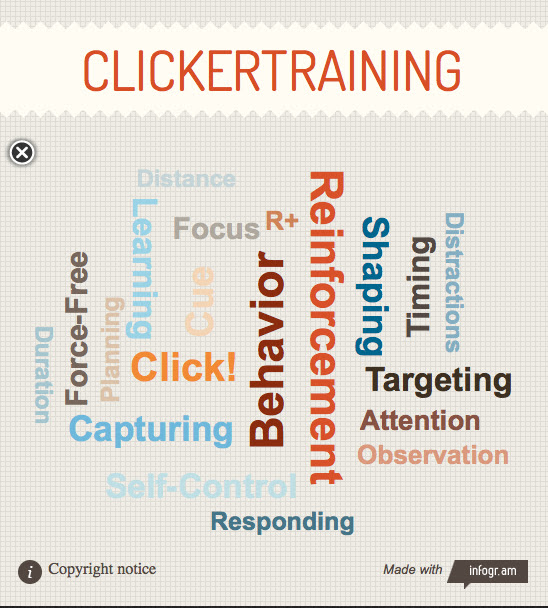
clickertraining infographic
I help dog owners transform their untrained animals into focused companions and responsive performance dogs - private, in-home training available in the Portland, Oregon metro area and training for attention and recall available online.  www.TrainPositiveDog.com   971-255-7466